

Female powerful names in history don’t come from imagination, they belong to real women who broke into laboratories, courtrooms, cockpits, and parliaments when the door was barely open a crack.
Marie Curie, Rosa Parks, Ada Lovelace, Frida Kahlo, and Malala Yousafzai are more than famous names; each one represents a woman who changed the direction of science, justice, art, or human rights, often against enormous odds.
This guide brings together the names of history’s most powerful women ranked by historians, grouped by field, and pulled from every continent and era, not just the most familiar Western figures; so you can choose a name with a real, documented story behind it.
You’ll find ranked lists, category tables by profession, a spotlight on global and lesser-known women, in-depth profiles of eight remarkable figures, and practical guidance for matching a name’s story to the meaning you want it to carry.
Unlike a typical baby-name list built purely around sound and popularity, everything here is anchored to a real historical record; a Nobel Prize, a documented first, a movement that measurably changed policy or public opinion, so whichever name you land on, you’ll have a genuine, well-sourced story to share when your daughter is old enough to ask where her name came from.
Why Do We Still Look to History for Powerful Female Names?
Naming a daughter after a historical figure is one of the oldest naming traditions there is, and it’s having a clear resurgence. Rather than choosing a name purely for its sound, more parents are searching specifically for names tied to real accomplishment, a scientist who won two Nobel Prizes, an activist who refused to move from her seat, a coder who wrote the world’s first computer algorithm a century before computers existed.
It also helps that historians themselves have spent years formally ranking and studying exactly this question.
In 2018, BBC History Magazine asked ten historians to each nominate ten women they believed had done the most to shape world history, creating a shortlist of 100 women that the public then voted on. The result offers a rare, expert-vetted answer to the question of which women’s names carry the most documented historical weight and it’s a great starting point for anyone searching for a name with real substance behind it.
At the same time, projects that celebrate lesser-known women from history; podcasts, blogs, and biography series focused on global figures the mainstream lists tend to skip, have grown just as popular.
Together, the two approaches give parents a genuinely wide field to choose from: expert-verified household names for those who want instant recognition, and rarer global figures for those who want a name that starts a conversation rather than confirms one.
The Top 10 Women Who Changed the World, According to Historians
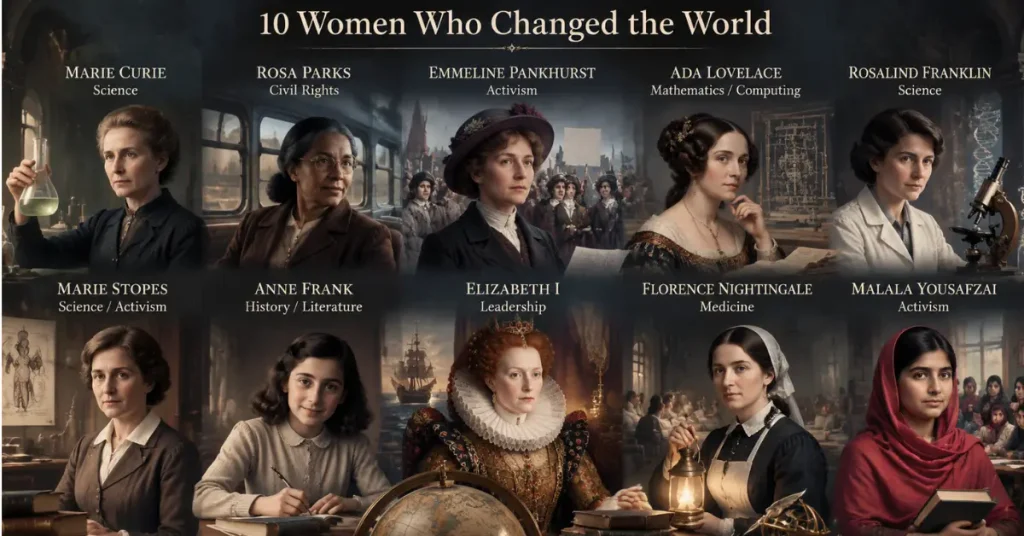
When BBC History Magazine’s expert panel and public vote were tallied, these ten names rose to the very top of the 100-woman shortlist, a genuinely diverse mix of scientists, activists, and pioneers.
| Rank | Name | Field | Why She Made the List |
| 1 | Marie Curie | Science | The only person to win Nobel Prizes in two different sciences, for her pioneering work on radioactivity. |
| 2 | Rosa Parks | Civil rights | Her refusal to give up her bus seat helped spark the American civil rights movement. |
| 3 | Emmeline Pankhurst | Activism | Led the British suffragette movement that won women the right to vote. |
| 4 | Ada Lovelace | Mathematics / computing | Wrote what’s considered the first computer algorithm, a century before computers existed. |
| 5 | Rosalind Franklin | Science | Her X-ray imaging was critical to discovering the structure of DNA. |
| 6 | Marie Stopes | Science / activism | A pioneering advocate for birth control access and women’s reproductive health. |
| 7 | Anne Frank | History / literature | Her diary became one of the most widely read personal accounts of the Holocaust. |
| 8 | Elizabeth I | Leadership | Ruled England for 44 years during a golden age of exploration and the arts. |
| 9 | Florence Nightingale | Medicine | Modernized nursing practices and drastically reduced hospital death rates. |
| 10 | Malala Yousafzai | Activism | The youngest-ever Nobel laureate, recognized for her advocacy for girls’ education. |
Female powerful names Inspired by Scientists & Innovators
Beyond the top-ranked names above, these women pushed science, math, and technology forward in ways that still shape daily life.
| Name | Meaning | Achievement |
| Katherine (Johnson) | Pure | NASA mathematician whose orbital calculations were critical to early American spaceflight. |
| Hedy (Lamarr) | Strife, or a Germanic root meaning “battle” | Actress and inventor whose frequency-hopping work laid groundwork for Wi-Fi and Bluetooth. |
| Grace (Hopper) | Grace, or God’s favor | Computer scientist who developed one of the first compilers and helped popularize programming languages. |
| Rachel (Carson) | Ewe (female sheep) | Marine biologist whose book Silent Spring helped launch the modern environmental movement. |
| Chien-Shiung (Wu) | Modest, elegant (approximate translation) | Physicist whose experiments disproved a long-held law of physics, though a Nobel Prize went only to her male colleagues. |
| Jane (Goodall) | God is gracious | Primatologist whose decades of chimpanzee research reshaped our understanding of animal behavior. |
Powerful Female Names Inspired by Activists & Suffragists
These women organized, marched, and spoke out at real personal risk to secure rights that many now take for granted.
| Name | Meaning | Achievement |
| Harriet (Tubman) | Ruler of the home | Escaped slavery and then risked her life repeatedly to guide others to freedom via the Underground Railroad. |
| Susan (B. Anthony) | Lily | A leading figure in the American women’s suffrage movement for over 50 years. |
| Sojourner (Truth) | One who travels; her chosen name reflected her mission | Abolitionist and women’s rights activist famous for her “Ain’t I a Woman?” speech. |
| Coretta (Scott King) | Little heart, from Greek Chorosetta | Civil rights leader in her own right, alongside and beyond her marriage to Dr. Martin Luther King Jr. |
| Gloria (Steinem) | Glory | Journalist and organizer who became one of the most recognized voices of second-wave feminism. |
| Wangari (Maathai) | Kikuyu name tied to leopard imagery | The first African woman to win the Nobel Peace Prize, for environmental and human rights activism. |
Powerful Female Names Inspired by Astronauts, Athletes & Pioneers
First-of-their-kind achievements in space, sport, and exploration make these names some of the most inspiring for a daughter with big ambitions.
| Name | Meaning | Achievement |
| Sally (Ride) | From the Old English for princess | The first American woman to travel to space, in 1983. |
| Mae (Jemison) | Pearl | The first Black woman to travel to space, and later a physician and engineer. |
| Valentina (Tereshkova) | Strong, healthy | The first woman in space overall, flying a solo Soviet mission in 1963. |
| Amelia (Earhart) | Work | The first woman to fly solo across the Atlantic Ocean. |
| Wilma (Rudolph) | Resolute protector | Overcame childhood illness to become the first American woman to win three Olympic gold medals in track. |
| Bessie (Coleman) | Consecrated to God (a form of Elizabeth) | The first Black woman and first Native American woman to hold a pilot’s license. |
Powerful Female Names Inspired by Queens & Leaders
Long before modern activism, these women held real political power, some of them ruling entire empires. If you are drawn to names connected with queens, rulers, and leadership, you may also want to explore these baby names inspired by royalty for more ideas rooted in strength, authority, and legacy.
| Name | Meaning | Achievement |
| Cleopatra | Glory of her father | The last active ruler of the Ptolemaic Kingdom of Egypt, remembered for her political skill and influence. |
| Boudica | Victory (Celtic) | A British queen who led a major uprising against Roman occupation. |
| Isabella (I of Castile) | Devoted to God | Ruled Spain jointly with Ferdinand, unifying the country and funding Columbus’s voyages. |
| Indira (Gandhi) | Beauty, or a name for the goddess Lakshmi | India’s first and, to date, only female Prime Minister. |
| Golda (Meir) | Golden | Israel’s first and only female Prime Minister, leading during the 1973 Yom Kippur War. |
| Eleanor (Roosevelt) | Light, or shining one | Transformed the role of First Lady into a platform for human rights advocacy. |
Global & Lesser-Known Powerful Women Throughout History
Most “women in history” lists lean heavily on 19th- and 20th-century Western figures. But remarkable women shaped every era and every continent, many of them centuries before the names above were even born. Widening the search turns up names that are just as powerful, and considerably rarer.
Projects dedicated specifically to this gap; podcasts and blogs that spend entire months profiling women from a single region or era, have found no shortage of material once they started looking beyond the usual shortlist.
From ancient Vedic scholars in India to pirate queens in North Africa to resistance leaders in colonial Angola, these women held real power and influence long before the more familiar 19th- and 20th-century names entered the history books most of us grew up reading.
| Name | Region / Era | Achievement |
| Hatshepsut | Ancient Egypt | One of the few female pharaohs, who ruled successfully for roughly two decades and expanded trade networks. |
| Gargi Vachaknavi | Ancient India | A revered philosopher and scholar in Vedic-era debates, among the few women recorded in that tradition. |
| Ban Zhao | Ancient China | Historian and scholar who completed one of China’s major dynastic histories and wrote influential texts on women’s education. |
| Wu Zetian | Tang Dynasty China | The only woman to rule China in her own right as emperor, reforming the civil service system. |
| Sayyida al-Hurra | 16th-century Morocco | A pirate queen and the last person in Islamic history to officially hold the title “al-Hurra” (female sovereign). |
| Nzinga (Mbande) | 17th-century Angola | A queen who led decades of resistance against Portuguese colonization. |
| Noor (Inayat Khan) | 20th-century India / UK | An Indian-British spy who worked undercover in Nazi-occupied France and was posthumously honored for her bravery. |
| Rigoberta (Menchú) | 20th-century Guatemala | Indigenous rights activist and Nobel Peace Prize laureate for her advocacy for Indigenous peoples. |
8 Remarkable Women’s Stories Behind the Names
A name means more once you know the story that shaped it. Here are eight women whose names consistently top history lists, along with what actually made each of them extraordinary chosen deliberately to span different fields, continents, and centuries rather than repeating the same handful of 20th-century figures.
1. Marie Curie — Two Nobel Prizes, One Relentless Curiosity
Marie Curie discovered two new elements, polonium and radium, and became the first person — man or woman — to win Nobel Prizes in two different scientific fields. Her two Nobel Prize achievements are documented by the Nobel Prize organization.
2. Rosa Parks — A Single Act That Shifted a Movement
In 1955, Rosa Parks refused to give up her seat on a segregated Montgomery, Alabama bus, an act of quiet defiance that led to her arrest and helped ignite the Montgomery Bus Boycott. She remains the first and only woman to have her casket lie in honor at the U.S. Capitol Rotunda.
3. Ada Lovelace — A Programmer Before Programming Existed
Working alongside inventor Charles Babbage in the 1840s, Ada Lovelace wrote what’s now recognized as the first algorithm intended to be processed by a machine — essentially the first computer program, written roughly a century before the first computer was built.
4. Malala Yousafzai — Surviving to Keep Speaking
Malala Yousafzai began advocating for girls’ education in Pakistan as a young teenager and survived being shot by the Taliban for it in 2012. She recovered and continued her advocacy internationally, becoming the youngest person ever to win the Nobel Peace Prize at age 17.
5. Frida Kahlo — Turning Pain Into Iconic Art
After surviving a near-fatal bus accident as a teenager that left her with lifelong chronic pain, Frida Kahlo channeled her physical and emotional experience into deeply personal self-portraits that explored identity, the body, and Mexican culture, making her one of the most recognized painters of the 20th century.
6. Wangari Maathai — Planting Millions of Trees
Wangari Maathai founded Kenya’s Green Belt Movement, which has since planted tens of millions of trees while simultaneously creating income opportunities for women and pushing back against deforestation. In 2004, she became the first African woman to win the Nobel Peace Prize.
7. Sacagawea — Guiding an Expedition Across a Continent
As a teenage Shoshone woman traveling with an infant, Sacagawea served as an interpreter and guide for the Lewis and Clark Expedition, using her knowledge of the terrain and local relationships to help secure safe passage and critical supplies across thousands of unfamiliar miles.
8. Hatshepsut — A Pharaoh Who Ruled as King
Hatshepsut ruled ancient Egypt as pharaoh — not merely as a queen consort — for around two decades, commissioning major building projects and expanding trade routes. She’s remembered as one of the most successful pharaohs of any gender, though later rulers tried to erase her monuments from the historical record.
Why the Same Few Names Keep Topping Every List?
If you’ve browsed more than one “powerful women in history” list before finding this one, you’ve probably noticed the same handful of names repeating: Marie Curie, Rosa Parks, Amelia Earhart, Eleanor Roosevelt.
That repetition isn’t laziness on the part of list-makers, it reflects a real pattern in how history has traditionally been recorded and taught, with English-language, 19th- and 20th-century, Western achievements documented far more thoroughly than events from other regions and eras.
That’s exactly why this guide splits things into two tiers: the historian-ranked, broadly recognized names in the tables above, and the global, lesser-known section further down. Both tiers are equally legitimate sources for a powerful name, the first gives you instant recognizability, and the second gives you a name that’s rare precisely because the record-keeping around her story hasn’t caught up yet.
How to Choose a Powerful Name Inspired by a Real Historical Woman?
Start by deciding which kind of power resonates with you. Some women on this list changed the world through public, visible defiance (Rosa Parks, Boudica), while others worked quietly for years before their contributions were recognized (Rosalind Franklin, Ada Lovelace).
Both are equally powerful stories, they just express strength differently, so pick the one that matches the tone you want your daughter’s name to carry.
Look beyond the most famous handful of names. Because a small group of figures, Marie Curie, Rosa Parks, Amelia Earhart, appear on nearly every list, their names are also among the most commonly chosen.
If you want something rarer with an equally powerful story, look to the global and lesser-known section above for names like Nzinga, Sayyida, or Ban Zhao.
Read the full story, not just the summary. A one-line achievement can undersell how difficult a woman’s path actually was Marie Stopes faced enormous public backlash for her work, and Sojourner Truth had to fight for her own freedom before she could fight for anyone else’s.
Understanding the full context makes the name mean more when you eventually explain it to your daughter.
Finally, consider using the full name only for the story, and a shortened or softened version day to day. Many parents choose a formal name tied to a historical figure — Eleanor, Rosalind, Valentina, while using an easier nickname like Nora, Ros, or Val in daily life, giving their daughter both the meaningful backstory and a name that’s simple to use growing up.
It’s also worth double-checking the version of the story you’ve heard, since popular retellings sometimes simplify or slightly distort a woman’s actual history. Rosa Parks, for example, is often described as simply being “too tired” to move, when she was in fact a longtime NAACP organizer whose refusal was part of a deliberate, ongoing civil rights strategy.
Frequently Asked Questions
Who is considered the most powerful woman in history?
According to a formal 2018 poll of historians conducted by BBC History Magazine, Marie Curie was voted the woman who did the most to shape world history, ahead of Rosa Parks and Emmeline Pankhurst.
What are good baby names inspired by powerful women in history?
Popular choices include Eleanor (Eleanor Roosevelt), Rosa (Rosa Parks), Amelia (Amelia Earhart), Ada (Ada Lovelace), and Frida (Frida Kahlo) — each tied to a documented, real achievement.
Are there powerful female names in history from outside the US and UK?
Yes, and there are far more than most lists include. Hatshepsut (Egypt), Wu Zetian (China), Nzinga (Angola), Rigoberta Menchú (Guatemala), and Sayyida al-Hurra (Morocco) each represent major historical impact well beyond Western history.
Is it common to name a child after a historical figure?
Yes, this is one of the oldest and most consistent baby-naming traditions, and it has seen renewed popularity as more parents search for names with documented, meaningful backstories rather than purely trend-driven choices.
What’s the difference between a name inspired by an activist versus a scientist?
Names tied to activists (Rosa, Harriet, Malala) tend to carry themes of courage and public resistance, while names tied to scientists (Marie, Ada, Rosalind) more often carry themes of quiet persistence, curiosity, and intellectual achievement both are strong, just in different registers.
Can a powerful historical name work well for a modern child?
Absolutely. Many of the names on this list, Eleanor, Amelia, Ada, Frida, Nora are already popular modern baby names in their own right, meaning your daughter gets both a stylish, current name and a meaningful historical story behind it.
Conclusion
Powerful female names in history connect a child to something rarer than a nice sound or a passing trend: documented proof that one determined person can genuinely change the course of events.
Whether you’re drawn to Marie Curie’s relentless curiosity, Rosa Parks’s quiet defiance, Hatshepsut’s ancient authority, or Malala Yousafzai’s courage under real danger, every name on this list carries a true story worth passing down.
